Why HITL Is a Layer, Not a Feature
Every AI agent platform claims to support "human-in-the-loop." Most of them mean: "We can send a Slack notification when the AI isn't sure."
That's not HITL. That's a notification.
Real human-in-the-loop is an architectural layer — not a feature you bolt on after the fact. And getting it right is the difference between an AI demo and an AI product your enterprise customers will actually deploy.
The Four HITL Patterns
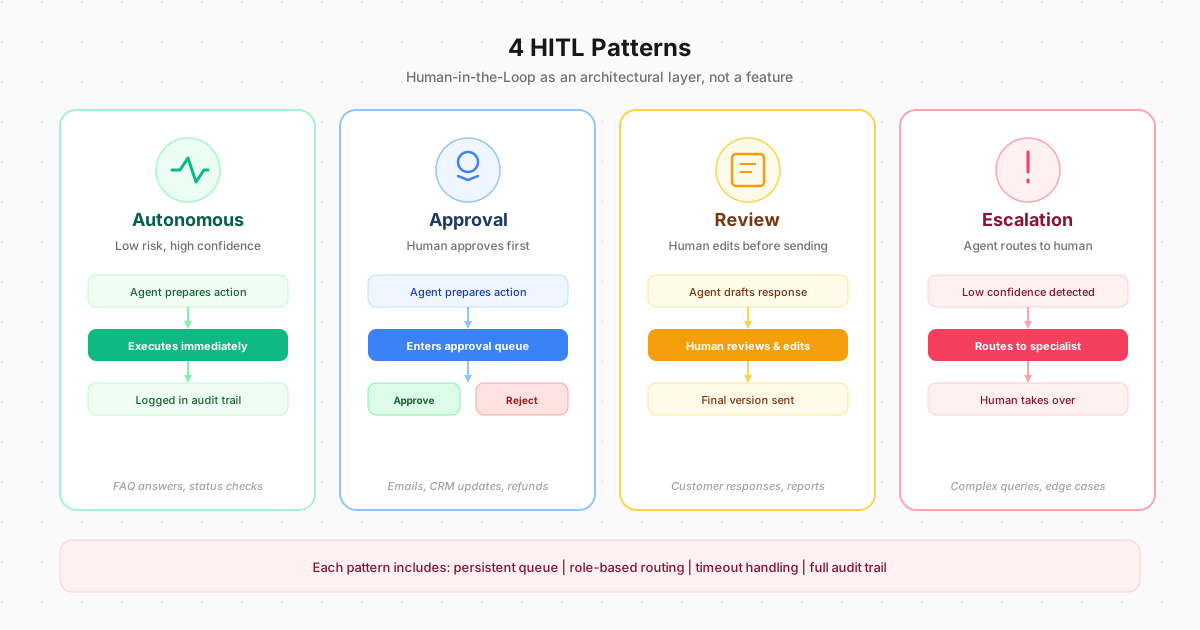
After studying how enterprises actually want to supervise their AI systems, we identified four distinct patterns. Each serves a different risk profile:
1. Autonomous
The agent acts without human intervention. This is appropriate for low-risk, high-confidence actions — like answering a FAQ from a knowledge base with a high confidence score.
When to use: The cost of a wrong answer is low, and the agent's confidence is high.
2. Approval
A human must approve the action before it executes. The agent prepares the action (draft an email, update a CRM record, process a refund) and a human clicks "Approve" or "Reject."
When to use: The action has real-world consequences — sending an email on behalf of the company, updating financial records, or making commitments to customers.
3. Review
Like Approval, but the human can edit the output before it's sent. The agent drafts a response, the human refines it, and only then does it go out.
When to use: The agent produces good first drafts but needs human judgment for tone, accuracy, or compliance.
4. Escalation
The agent detects that it's out of its depth and routes the conversation to a human. This isn't failure — it's intelligence. An agent that knows when to escalate is more trustworthy than one that always tries to answer.
When to use: Confidence is low, the query is out of scope, or the customer explicitly asks for a human.
Why Most Platforms Get This Wrong
Here's what "HITL" looks like on most AI platforms:
Agent does something → Sends Slack message → Hope someone notices
There's no queue. No timeout handling. No audit trail. No role-based routing. No way to track SLAs or measure response times. No fallback if the human doesn't respond within the expected window.
Compare that to what enterprise HITL actually requires:
Agent prepares action
  → Enters approval queue (persisted in database)
  → Routed to correct approver (role-based)
  → Approver reviews in dedicated UI
  → Approves, rejects, or edits
  → Action executes (or doesn't)
  → Full audit trail logged
  → Timeout triggers fallback behavior
The difference isn't cosmetic. It's architectural.
HITL as a Layer
In Kapi's 8-layer blueprint architecture, HITL is Layer 6 — sitting between Memory (Layer 5) and Eval (Layer 7). This placement is intentional:
- Below Eval because you want quality checks to run AFTER human edits
- Above Memory because human decisions should be remembered in context
- Parallel to Graph because HITL checkpoints are defined in the agent's workflow graph
When you configure a Kapi blueprint, you don't "enable HITL." You configure which actions need which pattern:
| Action | Pattern | Timeout | Fallback |
|---|---|---|---|
| Send customer email | Approval | 24 hours | Auto-approve |
| Update CRM record | Autonomous | — | — |
| Process refund > $500 | Review | 4 hours | Escalate to manager |
| Low-confidence response | Escalation | — | Route to support |
This isn't a feature toggle. It's a policy layer that governs how your agent interacts with the real world.
The Audit Trail Problem
Here's a question that comes up in every enterprise AI deployment: "Can you show me exactly what the agent did, who approved it, and when?"
If your HITL is "send a Slack message," the answer is no. Slack messages get lost. They're not queryable. They don't integrate with your compliance systems.
A proper HITL layer maintains:
- Action log: What the agent proposed to do
- Decision log: Who approved/rejected/edited, and when
- Diff log: What changed between the agent's proposal and the final action
- Timing log: How long each approval took (for SLA tracking)
- Compliance log: Which policy rule triggered the human review
This data isn't optional for regulated industries. It's a requirement.
The PM's Perspective
For product managers deploying AI agents, HITL configuration is one of the most important decisions you'll make. Too much oversight and the agent becomes a glorified autocomplete. Too little and you're exposed to real business risk.
The right approach is progressive: start with everything requiring approval, then gradually move well-understood actions to autonomous as you build confidence in the agent's behavior. Kapi's eval layer (Layer 7) helps you make this decision with data — you can see exactly how often the agent's proposals are approved without edits, which tells you which actions are ready for autonomous mode.
Building for Trust
Enterprise AI adoption isn't blocked by technology. It's blocked by trust. Decision-makers need to know that AI systems are supervised, auditable, and controllable.
HITL isn't the boring part of AI development. It's the part that makes everything else possible. Without it, you have a demo. With it, you have a product.
Every Kapi blueprint ships with configurable HITL patterns. See it in action.