Stop Vibe Coding. Start Engineering.
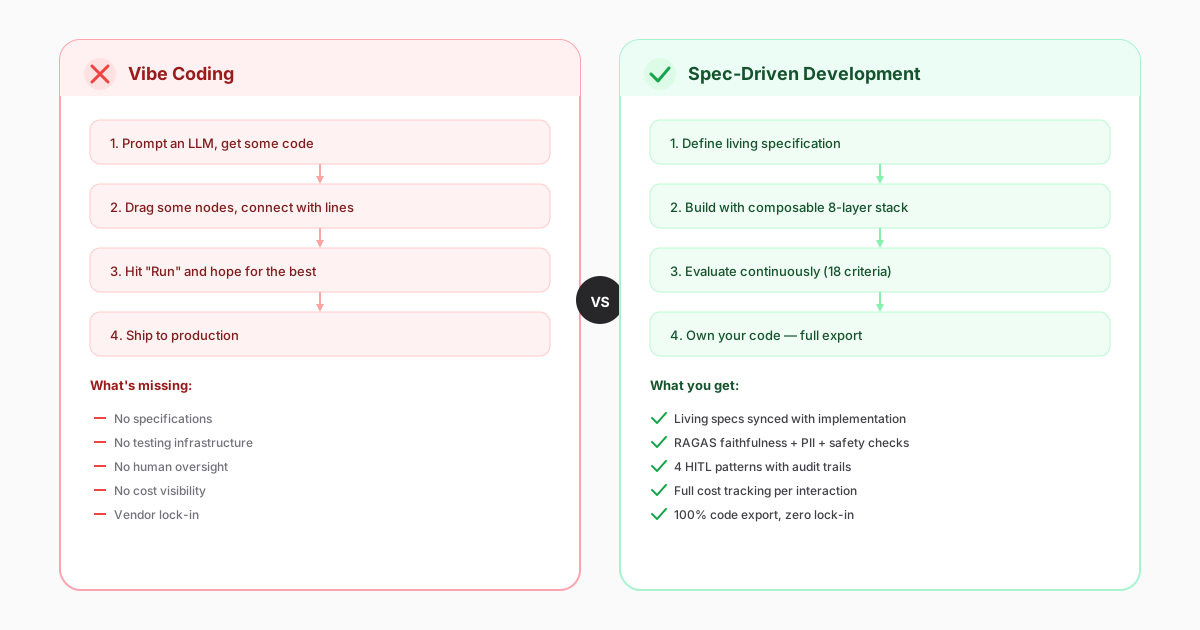
There's a new term floating around the AI development world: vibe coding. It sounds fun — just prompt an LLM, get some code, ship it, iterate. No specs, no architecture, no testing. Just vibes.
And for a weekend hackathon, it works great.
But for enterprise AI products? It's a disaster waiting to happen.
The Problem with Vibe Coding
We analyzed 9 major AI development platforms — Dify, CrewAI, n8n, Gumloop, Lindy, StackAI, and others. Every single one encourages some version of this workflow:
- Drag some nodes onto a canvas
- Connect them with lines
- Hit "Run" and hope for the best
What's missing? Specifications. Nobody writes down what the system should do before building it. Nobody defines success criteria. Nobody sets up evaluation frameworks. The result is what we call "AI slop" — systems that demo well but fail in production.
What Goes Wrong
When you skip specifications, you get predictable failure modes:
No testing infrastructure. Would you ship traditional code without tests? Then why are we shipping AI agents without evaluation frameworks? Most platforms don't even have a concept of "test suite" for agent behavior.
No human oversight. When an AI agent sends an email on behalf of your company, who approved it? Most platforms offer "escalate to Slack" as their HITL solution. That's not human oversight — that's a notification.
No cost visibility. A single poorly-configured agent can burn through $500 in API calls in an afternoon. Without observability baked in, you won't know until the invoice arrives.
Vendor lock-in. You built something great on a visual canvas. Now try deploying it on your own infrastructure. Most platforms make this impossible — your IP lives on their servers, in their proprietary format.
The Alternative: Spec-Driven Development
At Kapi, we believe AI development should follow the same rigor as traditional software engineering — adapted for the unique challenges of non-deterministic systems.
Here's what that looks like:
1. Start with a Living Specification
Before any code runs, you define:
- What the agent should do (and explicitly what it should NOT do)
- Success criteria with measurable thresholds
- Human review points and escalation rules
- Cost budgets per interaction
2. Build with Composable Components
Instead of monolithic "flows," Kapi blueprints are built from 8 distinct layers — UI, Graph, Integrations, Knowledge, Memory, HITL, Eval, and Observability. Each layer can be configured independently and tested in isolation.
3. Evaluate Continuously
Every blueprint ships with built-in evaluations: faithfulness scoring, PII detection, toxicity checks, and compliance criteria. These aren't add-ons — they run on every interaction.
4. Own Your Code
When you're ready to deploy, export everything. Full source code, specifications, test suites, deployment configs. No vendor lock-in. Your team owns every line.
The 8-Layer Difference
Most platforms give you 2-3 layers (UI + some orchestration) and call it a product. Here's what a complete AI application stack actually looks like:
| Layer | What It Does | Why It Matters |
|---|---|---|
| UI | Chat, forms, tables, dashboards | Users need to interact with your agent |
| Graph | Routing, planning, multi-agent orchestration | Complex tasks need structured workflows |
| Integrations | CRM, email, Slack, 150+ connectors | Agents need to act in the real world |
| Knowledge | RAG, vector search, document chunking | Agents need access to your data |
| Memory | Cross-session context, user preferences | Users expect continuity |
| HITL | Approval queues, escalation, review | Humans must stay in control |
| Eval | Quality metrics, safety guardrails | You need to know it's working |
| Observability | Tracing, cost tracking, debugging | You need to know when it's not |
Skip any of these layers and you're shipping an incomplete product. Most "vibe coding" platforms give you layers 1-2 and maybe a bit of layer 4. The rest? That's your problem.
A Better Way
The AI development ecosystem is maturing. The tools that will win aren't the ones that make the flashiest demos — they're the ones that help you ship reliable, tested, human-supervised AI systems that your enterprise customers can actually trust.
Stop vibe coding. Start engineering.
Kapi provides spec-driven development for AI applications. Start a project to see the difference.