Spec-Driven Development: A New Paradigm for AI
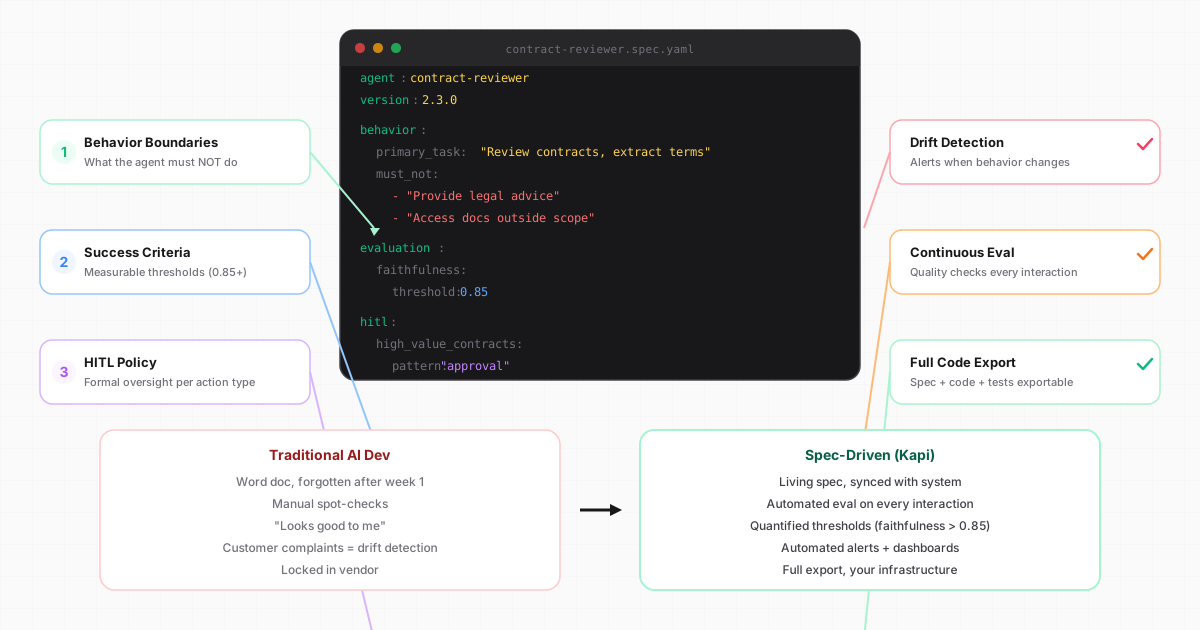
In traditional software development, the spec-to-code gap is a well-known problem. Requirements are written in one document, code is written in another, and over time the two diverge until the spec is fiction and the code is the only source of truth.
For AI applications, this problem is 10x worse.
The AI Specification Problem
AI agents are non-deterministic. The same input can produce different outputs depending on context, model temperature, retrieved documents, and a dozen other variables. This makes traditional specification approaches — "given X input, produce Y output" — fundamentally inadequate.
What does a specification for an AI agent even look like?
Most teams skip this question entirely. They go straight to building: wire up some API calls, add a system prompt, test a few examples manually, and call it done. This is the "vibe coding" approach, and it works right up until it doesn't.
What We Mean by Spec-Driven
At Kapi, spec-driven development means three things:
1. Specifications Are Living Documents
A Kapi spec isn't a static document that gets written once and forgotten. It's a structured configuration that stays in sync with the running system:
agent: contract-reviewer
version: 2.3.0

behavior:
  primary_task: "Review contracts and extract key terms"
  must_not:
    - "Provide legal advice"
    - "Make recommendations on contract acceptance"
    - "Access documents outside the assigned scope"

  escalation:
    conditions:
      - "Contract value exceeds $1M"
      - "Non-standard indemnification clauses detected"
      - "Confidence score below 0.7"
    target: "legal-team"

evaluation:
  faithfulness:
    threshold: 0.85
    source: "retrieved_documents"
  completeness:
    required_fields:
      - "parties"
      - "effective_date"
      - "termination_clauses"
      - "payment_terms"
      - "liability_caps"

hitl:
  send_summary_email:
    pattern: "review"
    timeout: "4h"
    fallback: "escalate"
  flag_risk_clause:
    pattern: "approval"
    timeout: "24h"
    fallback: "hold"
This spec is both human-readable documentation AND machine-executable configuration. When you change the spec, the agent's behavior changes. When the agent's behavior drifts from the spec, you get an alert.
2. Specs Define Success Criteria
Every Kapi spec includes evaluation criteria with measurable thresholds. This transforms "does it work?" from a subjective judgment into a quantifiable metric:
- Faithfulness > 0.85: At least 85% of the agent's claims must be grounded in retrieved documents
- Completeness check: Every contract review must extract all required fields
- Safety guardrails: PII must be detected and redacted before output
- Cost ceiling: No single interaction should exceed $0.50 in API costs
These criteria aren't aspirational — they're enforced. Every interaction is evaluated, and failures trigger alerts or HITL escalation.
3. Specs Enable Drift Detection
The most insidious problem with AI systems is silent drift. The system works fine for weeks, then a model update changes behavior slightly, or a new document in your knowledge base introduces conflicting information, and suddenly your agent is producing subtly wrong outputs.
Spec-driven development catches this because:
- Evaluation criteria run on every interaction (not just during testing)
- Statistical quality scores are tracked over time
- Significant deviations from baseline trigger alerts
- A/B comparisons are built into the deployment pipeline
Traditional vs. Spec-Driven: A Comparison
| Aspect | Traditional AI Dev | Spec-Driven (Kapi) |
|---|---|---|
| Requirements | Word doc, forgotten after week 1 | Living spec, synced with system |
| Testing | Manual spot-checks | Automated eval on every interaction |
| Success criteria | "Looks good to me" | Quantified thresholds (faithfulness > 0.85) |
| Drift detection | Customer complaints | Automated alerts + dashboards |
| HITL policy | Ad-hoc | Formally specified per action |
| Code ownership | Locked in vendor | Full export, your infrastructure |
| Audit trail | Non-existent | Complete, queryable, compliant |
The PM-Developer Handoff
One of the biggest benefits of spec-driven development is that it creates a clean contract between product managers and developers.
PMs define:
- What the agent should do (and must not do)
- Which actions need human approval
- Quality thresholds and cost budgets
- Escalation rules and fallback behavior
Developers implement:
- The technical architecture that satisfies the spec
- Integration with enterprise systems
- Performance optimization
- Deployment and monitoring infrastructure
The spec is the shared language. When a PM says "this agent needs to be more accurate," they can point to the faithfulness threshold and say "we need this above 0.90 instead of 0.85." When a developer says "this HITL pattern is creating bottlenecks," they can show the timeout data and propose moving specific actions to autonomous mode.
Getting Started
If you're building AI agents today without specifications, here's a pragmatic path to adoption:
Start with behavior boundaries. Before your next sprint, write down what your agent must NOT do. This is the most valuable part of any spec.
Add evaluation criteria. Pick one metric — faithfulness is a good start — and measure it on every interaction. You'll be surprised by the variance.
Define your HITL policy. For each action your agent takes in the real world, decide: autonomous, approval, review, or escalation? Write it down.
Track drift over time. Plot your evaluation scores weekly. When they change, investigate why.
Export and own. Make sure you can take your agent's code, specs, and test suites to any infrastructure. If you can't, you don't really own your AI.
The Future
As AI agents become more capable and more autonomous, the need for rigorous specification will only grow. We're moving from a world where AI is a tool (a human decides, AI executes) to a world where AI is an agent (AI decides, human supervises). In that world, specifications aren't optional overhead — they're the governance framework that makes autonomous AI systems safe and trustworthy.
Spec-driven development isn't just a better way to build AI. It's the only way that scales.
Kapi blueprints ship with living specifications, built-in evaluations, and full code export. Try it today.